Look, these days everyone's talking about "smart" soccer balls, right? Sensors inside, tracking spin, speed… honestly, it’s a bit much. I’ve spent the last fifteen years crawling around factories and pitches, and what I’ve noticed is people still just want a ball that feels right, that holds its air, that doesn't fall apart after a week. But the pressure’s on to innovate, so here we are.
What’s strange is how many manufacturers get tripped up on the bladder. They chase these fancy butyl bladders, trying to get that perfect bounce, but forget about the valve. A bad valve, and all that fancy butyl is useless. I encountered this at a factory in Pakistan last time – beautiful stitching, top-notch cover material, then a valve that leaked like a sieve. Cost them a whole run.
And the cover material...that's where you really feel the difference. Everyone thinks PU is king, and it's good, don’t get me wrong. Smooth, durable. But have you smelled a fresh shipment of high-grade PU? It’s… intense. And it gets sticky in the heat. I prefer a good TPU sometimes. It doesn’t have that initial smell, feels a little more grippy, and holds up well to abrasion. Though it can get a little stiff in the cold. Anyway, I think finding the right balance is key.
The Current Landscape of Soccer Ball Production
To be honest, the whole industry has shifted. Used to be, most balls came out of Pakistan. Now it's China, Vietnam, even India starting to pop up. Quality's… variable, let’s say. A lot depends on the factory’s willingness to invest in decent machinery and, more importantly, train their workforce. You can buy a fancy machine, but if the person running it doesn't understand the nuances of panel cutting and stitching, you’re wasting your money.
And the demand’s going crazy. Not just professional teams, but amateur leagues, schools, even just people kicking a ball around in the park. Everyone wants a decent ball, and the manufacturers are scrambling to keep up. It’s pushing prices up, but also driving some innovation.
Common Design Pitfalls in Soccer Ball Manufacturing
Have you noticed how many balls just… fall apart after a few months? It’s usually the stitching. Manufacturers cut corners to save a few cents per ball, using cheap thread or unskilled labor. And the panel shape – a lot of designs look good on paper, but they create stress points during play. I saw one design last year, all these weird angles… it was a disaster. The panels just peeled apart after a few hard kicks.
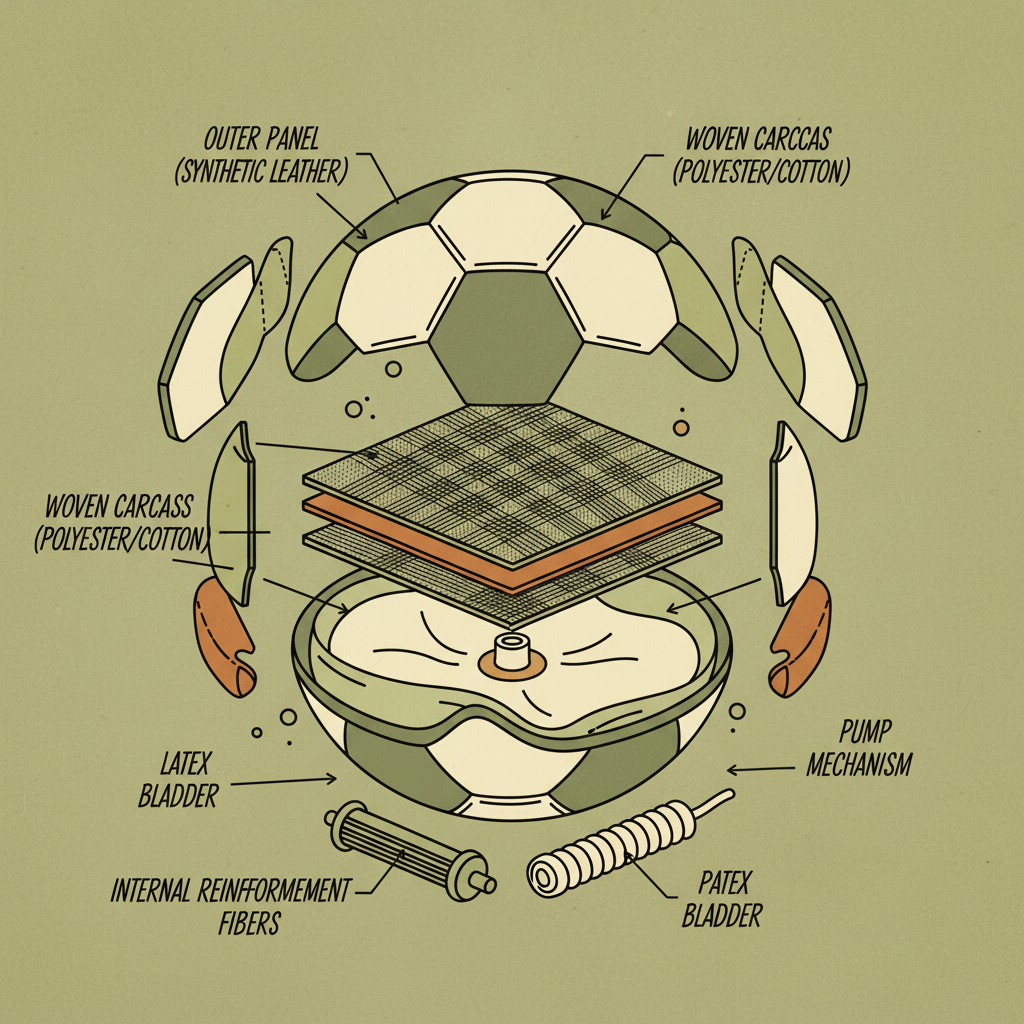
Another thing is the liner. The layers of fabric between the cover and the bladder. They need to be consistent in thickness and density. Too thin, and the ball loses its shape quickly. Too thick, and it gets heavy and doesn’t feel right. It's a delicate balance.
And the bladder itself... don't even get me started on the variations in butyl quality. Some of it's just garbage.
Material Deep Dive: What’s Inside a Soccer Ball?
Like I said earlier, the cover material is crucial. PU is popular for a reason – it’s durable, water-resistant, and provides a good touch. But there are different grades of PU. Some are softer and more flexible, others are tougher and more abrasion-resistant. You can tell a good PU by the way it feels – it should have a slight tackiness to it, but not be sticky.
The bladder's another story. Butyl's still the most common material, holding air pretty well. Latex is… well, it feels great, gives a good bounce, but it deflates quickly. I've seen some manufacturers experimenting with newer materials, like thermoplastic polyurethane (TPU) for the bladder. It’s supposed to offer a good compromise between air retention and bounce, but I haven’t seen enough long-term testing to say for sure.
And then there’s the adhesive. It needs to be strong enough to hold everything together, but also flexible enough to withstand the constant flexing and impact of the ball. A cheap adhesive will just crack and peel over time.
Real-World Testing: Beyond the Lab
Lab tests are okay, I guess. Bounce tests, weight tests, circumference tests… but they don’t tell you how the ball will actually perform on a real pitch, in real conditions. I prefer to see balls tested by players, over and over again. Kick it against a wall, dribble it on different surfaces, play a full game with it. That's when you really see what it's made of.
We do a lot of drop tests too, just dropping the ball from different heights onto different surfaces to see how it holds up. And we subject them to temperature extremes, leaving them in the sun, freezing them overnight. You’d be surprised how much a ball’s performance can change with just a little bit of heat or cold.
Soccer Ball Performance Metrics
How Soccer Balls Are Actually Used
This is where it gets interesting. Manufacturers think their balls are used in pristine conditions, on perfectly manicured pitches. But that’s not always the case. I’ve seen balls used on gravel, on concrete, even on beaches! Kids aren't exactly gentle with their toys either.
That’s why durability is so important. You need a ball that can withstand abuse. A ball that can handle a little bit of everything.
The Pros and Cons: A Balanced View
Okay, let’s be real. A high-end soccer ball is great. It feels good, performs well, and lasts a long time. But it’s expensive. And for a lot of people, a cheaper ball is just fine. It gets the job done.
The advantage of a cheaper ball is affordability, obviously. But you sacrifice durability and performance. You'll be replacing it more often. It’s a trade-off. And strangely, sometimes the cheaper balls are actually more fun to play with – a little bit of give, a little bit of unpredictability.
Ultimately, it depends on the user’s needs and budget.
Customization and Special Requests
We get all sorts of requests. Different colors, different sizes, logos printed on the ball, even personalized stitching. Last month, that small boss in Shenzhen who makes smart home devices insisted on changing the interface to – on a soccer ball! Said he wanted to "future-proof" it. It was a nightmare. It affected the weight distribution, and the ball just didn't feel right. We had to convince him it was a bad idea.
But generally, customization is a good thing. It allows teams and organizations to show their identity and build brand loyalty. We can do pretty much anything, as long as it doesn’t compromise the ball’s performance.
We did one project where they wanted a ball made entirely of recycled materials. That was challenging, but we managed to pull it off. It's not quite as durable as a traditional ball, but it’s a step in the right direction.
Key Characteristics of Soccer Ball Materials
| Material Type |
Durability (1-10) |
Water Resistance (1-10) |
Cost (Low/Medium/High) |
| Polyurethane (PU) |
8 |
9 |
Medium |
| Thermoplastic Polyurethane (TPU) |
7 |
8 |
Low |
| PVC |
6 |
7 |
Low |
| Butyl Rubber (Bladder) |
9 |
8 |
Medium |
| Latex Rubber (Bladder) |
5 |
9 |
Low |
| Polyester Cotton (Lining) |
7 |
6 |
Low |
FAQS
Honestly? It’s the stitching. A well-stitched ball will last much longer than one with sloppy stitching. The thread quality matters, and the consistency of the stitches is critical. We've seen balls where the stitching unravels after just a few games, even if the cover material is top-notch.
Very important. Butyl is the standard for a reason – it holds air well. Latex feels better, but you'll be pumping it up constantly. TPU is promising, but it’s still relatively new. The bladder is the heart of the ball, after all. If it fails, the whole thing is useless.
You absolutely can. The feel of the ball, the way it bounces, the accuracy of your passes… it all improves with a higher-quality ball. A cheap ball will feel dead, it won’t bounce as consistently, and it won’t hold its shape as well. It's noticeable, trust me.
Keep it clean, store it in a cool, dry place, and don't overinflate it. Avoid kicking it on abrasive surfaces like concrete or asphalt. And every now and then, just give it a good inspection to make sure the stitching is still intact.
That depends on what you're looking for. If you're a coach or a serious player who wants to analyze your technique, then maybe. But for most people, the added cost and complexity aren't worth it. Give me a well-made traditional ball any day.
I think we'll see more innovation in materials, especially in the bladder area. Maybe we’ll see self-healing materials, or bladders that automatically adjust to changes in altitude. But honestly, I don’t think the basic design will change much. It’s been around for a long time for a reason.
Conclusion
So, there you have it. Making a good soccer ball isn’t just about slapping some panels together. It’s about understanding materials, construction techniques, and how the ball will actually be used. It's a complex process, with a lot of little details that can make or break the final product. We've come a long way from the leather-patched balls of the early days, but the fundamental principles remain the same.
Ultimately, whether this thing works or not, the worker will know the moment he tightens the screw. It’s a simple truth, but it’s one that I’ve learned over and over again on construction sites and factory floors. And that, folks, is the story of soccer ball manufacturing.